Glen
Glen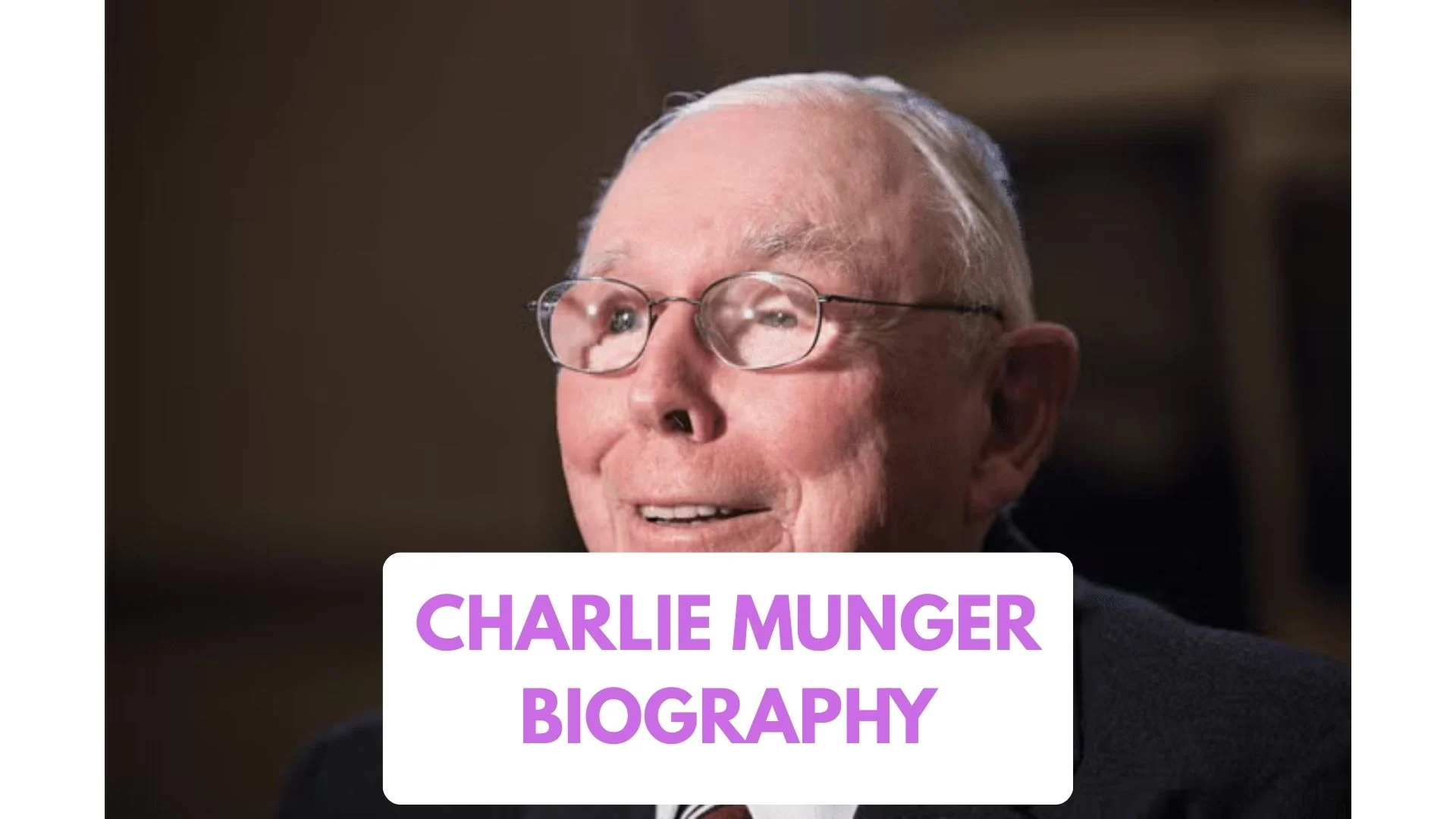
Charlie Munger — formally Charles Thomas Munger — is one of the most influential minds in modern investing.
Known as Warren Buffett’s wise and sometimes acerbic partner at Berkshire Hathaway, Munger combined legal training, intellectual curiosity, and a latticework of mental models to approach decisions with uncommon clarity.
This biography explores his early life, career highlights, investing philosophy, philanthropy, and the enduring lessons his life offers to investors, students, and lifelong learners.
Data
- Full Name: Charles Thomas Munger
- Born: January 1, 1924
- Died: November 28, 2023
- Birthplace: Omaha, Nebraska, U.S.
- Nationality: American
- Occupation: Businessman, investor, lawyer, philanthropist
- Parents: Alfred Case Munger (father) and Florence “Toody” Russell (mother)
- Spouse: Nancy Jean Huggins (married 1945, divorced 1953), Nancy Barry Borthwick (married c. 1956; died 2010)
- Children: Seven children (three with first wife, four with second) plus two stepchildren from second marriage.
- Net Worth: About US$ 2.6 billion at the time of his death.
Early Life and Education
Charles T. Munger was born in Omaha, Nebraska, on January 1, 1924. Raised in the same city that produced Warren Buffett, Munger showed early intellectual promise. He enrolled at the University of Michigan to study mathematics, but like many of his generation he paused his education to serve in World War II. After military service — where he trained as a meteorologist in the U.S. Army Air Corps — Munger attended Caltech and later studied law at Harvard Law School, graduating near the top of his class. His legal training shaped his clear, analytical thinking and ability to dissect complex problems.
From Law to Investing
Munger began his professional life as a lawyer and later co-founded the law firm Munger, Tolles & Olson in Los Angeles. While he built a successful legal career, his fascination with markets and business gradually led him away from practicing law full-time. In the 1960s he formed investment partnerships, and over time his returns and reputation grew.
The turning point came when Munger linked up with Warren Buffett. Their personalities and approaches complemented one another: Buffett’s patient, value-oriented investing and Munger’s intellectual rigor and contrarian instincts made a powerful combination. In the decades that followed, Munger served as vice chairman of Berkshire Hathaway and guided decision-making with memorable aphorisms and a devotion to multidisciplinary thinking.
Investing Philosophy: Mental Models & Rationality
Charlie Munger’s most enduring contribution to thinking about investing isn’t a tip about a stock — it’s a framework for thinking. He popularized the idea of using a “latticework of mental models” drawn from multiple disciplines (economics, psychology, engineering, biology, statistics, and more) to make better decisions.
- Invert, always invert: Solve problems by thinking about the opposite — what kills success — and avoid those things.
- Circle of competence: Know the limits of what you truly understand and act within them.
- Psychology of human misjudgment: Beware cognitive biases (confirmation bias, incentive-caused bias, social proof, etc.) and build systems to reduce their impact.
- Margin of safety & quality: Prefer exceptional businesses at fair prices to mediocre businesses at cheap prices.
- Patience and discipline: The best opportunities often require waiting for the right moment.
Partnership with Warren Buffett
The Munger-Buffett partnership changed modern capital allocation. Munger encouraged Buffett to move away from strict securities-only value investing toward buying wonderful businesses at reasonable prices — an intellectual pivot that helped Berkshire become a conglomerate of strong operating companies. Munger served as the moral and intellectual counterweight in boardrooms and shareholder meetings, often cutting through obfuscation with plainspoken logic.
Philanthropy, Architecture, and Education
Beyond investing, Munger was an active philanthropist with an interest in education and architecture. He made major donations to universities (including the University of Michigan and Stanford) and funded residential and library projects with a distinctive architectural vision. Munger insisted on clear design principles for buildings he sponsored and often involved himself in design details — sometimes controversially — because he saw physical environments as an extension of intellectual life.
Personal Life and Character
Munger married twice and raised a family while pursuing his varied interests. Known for his dry wit, blunt assessments, and voracious reading habits, he exemplified lifelong learning. He prized independence of thought, often criticizing faddish trends and empty intellectualism. His insistence on rationality and long-term thinking influenced not just investors but a wider community of entrepreneurs, academics, and readers.
Legacy and Influence
Charlie Munger left a legacy that transcends balance sheets. He reshaped how many serious investors think about decision-making, risk, and human bias. Concepts such as “mental models” and the need to read widely have entered the mainstream largely thanks to his advocacy. Munger’s clear, moral insistence on honesty, competence, and sound incentives continues to influence leaders across business, law, and academia.
Conclusion
Charlie Munger’s biography is not merely the story of a successful investor; it’s a blueprint for thinking better. From the courtroom to the boardroom, he modeled intellectual breadth, moral clarity, and ruthless practicality. Whether you’re an investor, student, or professional, Munger’s lessons — invert problems, know your circle of competence, and use a latticework of mental models — are timeless tools for better decisions and a more purposeful life.
FAQs
Who was Charlie Munger?
Charlie Munger (Charles T. Munger) was the longtime vice chairman of Berkshire Hathaway, a lawyer-turned-investor, philosopher of decision-making, and Warren Buffett’s close partner.
When and where was Charlie Munger born?
He was born in Omaha, Nebraska, on January 1, 1924.
What is Charlie Munger known for besides investing?
He is known for promoting the use of mental models, his philanthropy (notably to universities), and his interest in architecture and education.
What book collects Munger’s thoughts and speeches?
Poor Charlie’s Almanack is the most popular compilation of his speeches, aphorisms, and essays.
What are “mental models”?
Mental models are simple, discipline-based frameworks (from psychology, economics, biology, physics, etc.) that help explain reality and support better decision-making when combined.
How did Munger influence Warren Buffett?
Munger influenced Buffett to buy great businesses (not just undervalued stocks) and to think across disciplines, which led to Berkshire Hathaway’s transformation.

 Glen
Glen